


Red Light Therapy Wavelengths: What 660 nm and 850 nm Tell You
Oct 15,2026 | LumHarbor
Red Light Therapy Wavelengths — Quick Answer
Red light therapy wavelengths describe the light a device is listed as emitting, rather than how much light reaches you or how well a treatment works. A 660 nm label identifies visible red light; 850 nm identifies near-infrared, which is outside normal human vision. Neither number is a strength score. To interpret a device, distinguish its nominal labels from measured peaks and spectral width, then check how output is distributed across bands under the relevant conditions. More wavelengths do not automatically establish better results. Research must match the actual intervention and outcome; a combination study cannot identify each wavelength’s independent contribution. Follow the exact device’s directions, including specified eye protection.
Reading red light therapy wavelengths: start with the label
The “nm” stands for nanometers, a unit of length. Wavelength describes the spacing between successive wave peaks, as NASA’s explanation of light and matter illustrates. It does not describe electrical consumption, the amount of light reaching a surface, or a treatment result.
That distinction matters when comparing 660 nm and 850 nm. The larger number describes a longer wavelength, not a more powerful device. Similarly, two panels can list the same wavelengths while delivering different exposures.
| Listed wavelength | Spectral category | What the label alone does not establish |
|---|---|---|
| 630 nm or 660 nm | Visible red | Measured output, a specific skin result or a complete emission spectrum |
| 810 nm, 830 nm or 850 nm | Near-infrared | A fixed tissue depth, a clinical benefit or suitability for direct eye exposure |
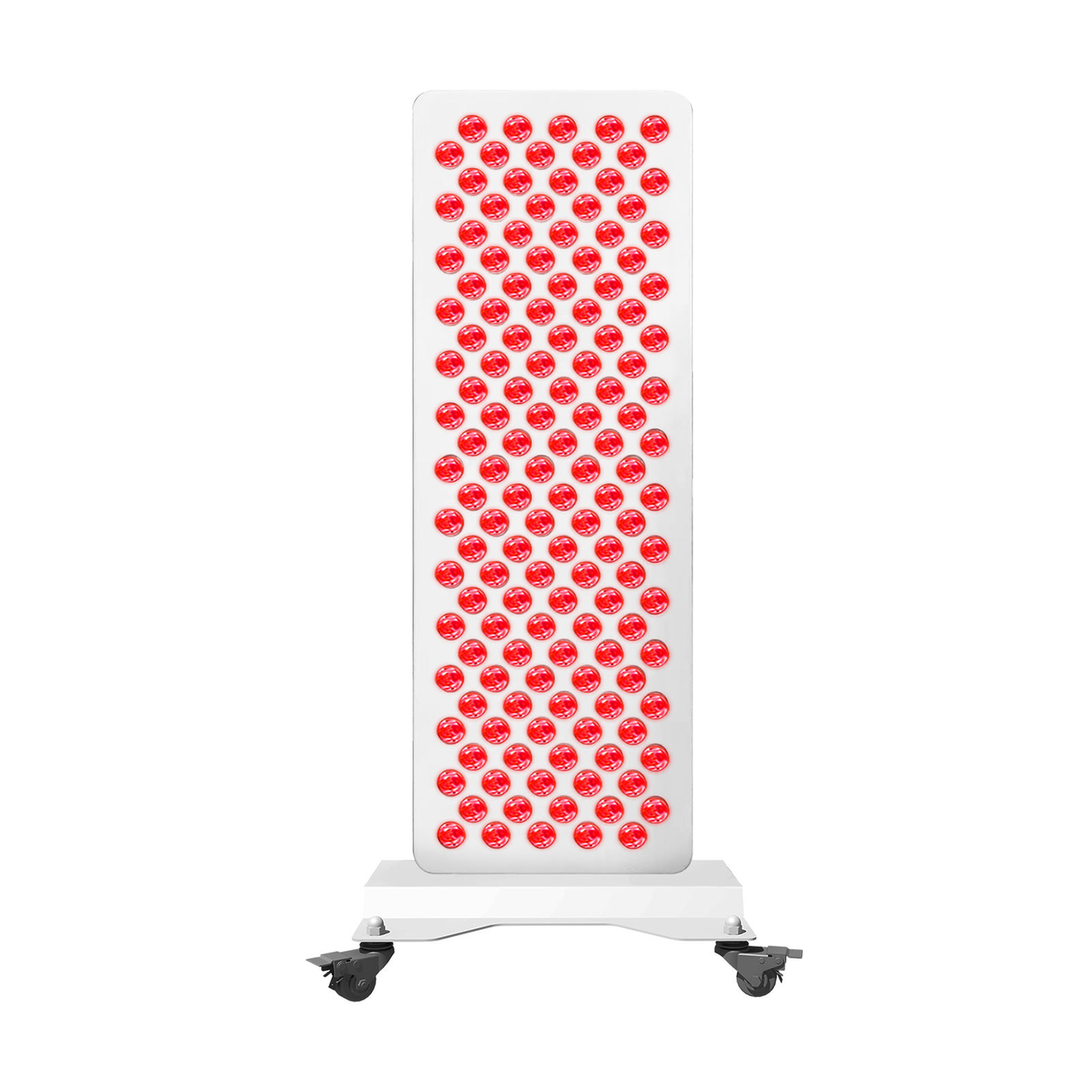
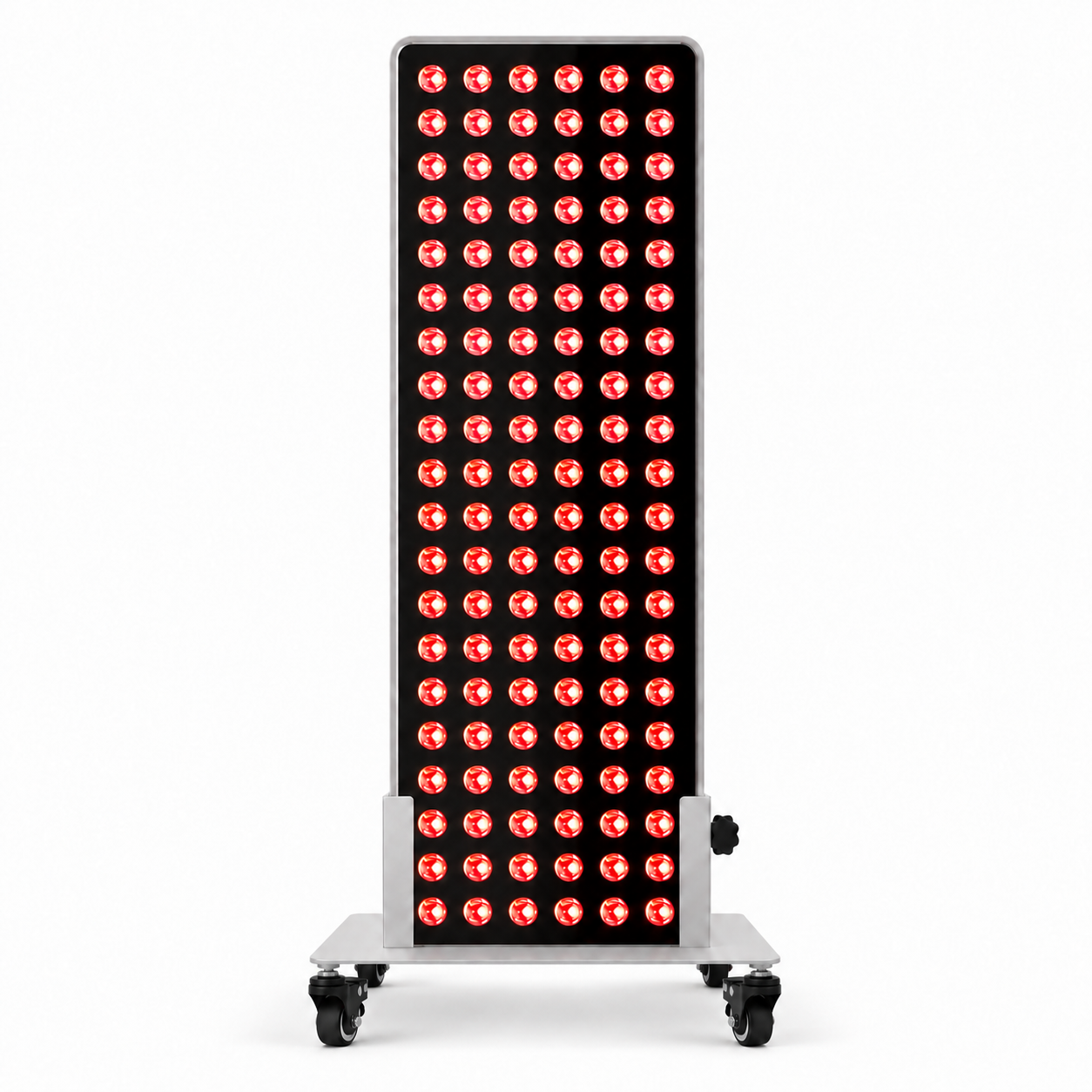
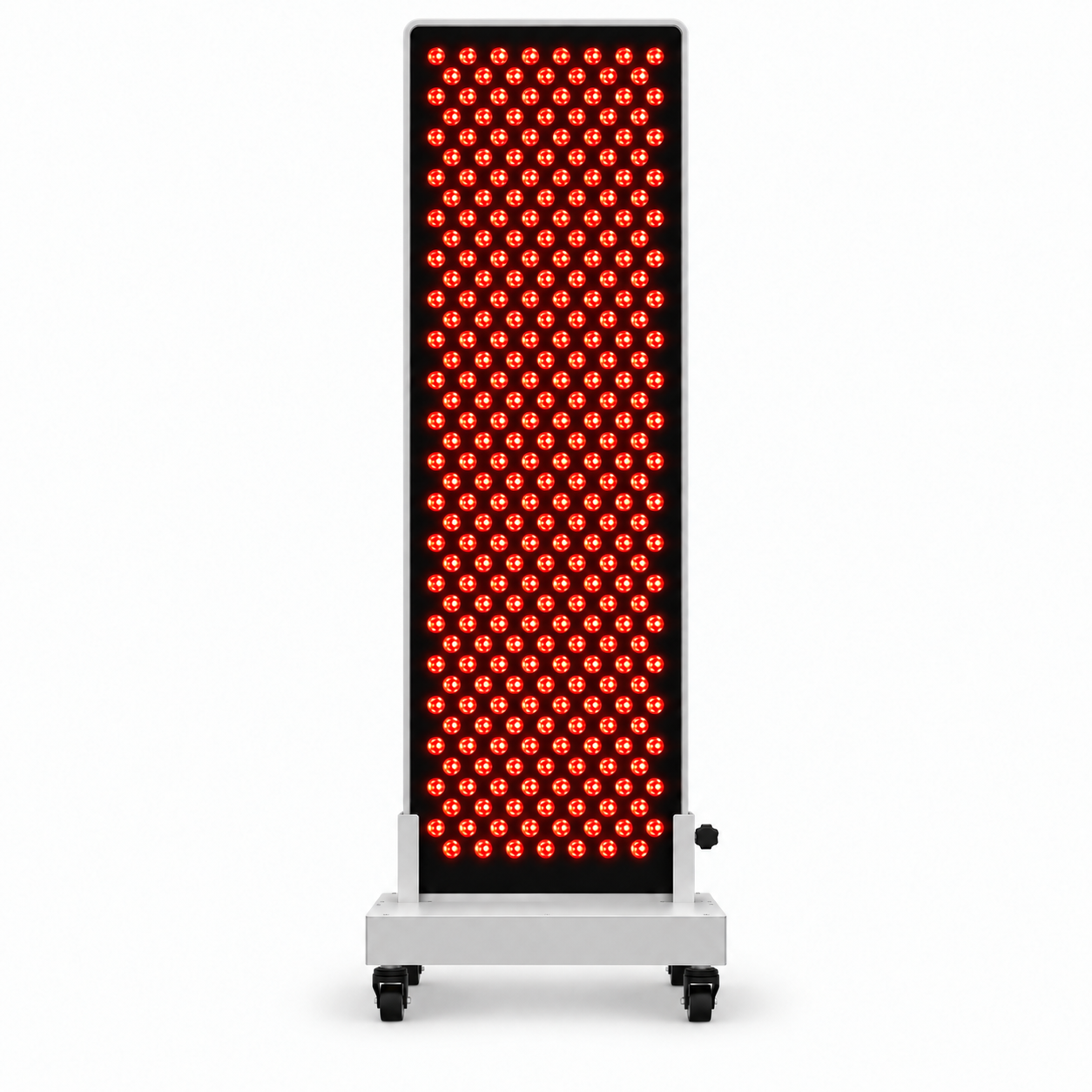
Near-infrared sits beyond visible red within the wider infrared spectrum. A near-infrared component can therefore be active without looking like a bright red emitter. Appearance alone cannot confirm either normal operation or a fault; use the manufacturer’s documented checks rather than inspecting the lights directly.
For the general biological background and evidence limits, see our introduction to red light therapy.

A wavelength label is not the whole spectrum
Three terms help when reading a specification. A nominal wavelength is the label assigned to a source; ask how the manufacturer defines it. A measured peak identifies where an emission spectrum reaches its maximum under the stated test conditions. Spectral width describes how emission extends around that peak.
Do not assume that every “660 nm” label means all emitted light is exactly 660 nm, or that every supplier uses “nominal” and “peak” interchangeably. A list of labels also cannot certify the absence of other emissions.
The useful question about red light therapy wavelengths is what the label leaves unspecified. Technical guidance on radiometry treats peak wavelength, spectral width and spectral irradiance as separate information. A measured spectrum can describe the source more fully; it still does not, by itself, prove a health benefit.
One total reading does not reveal every band
A combined output figure does not identify how much each wavelength band contributes. Two devices could have the same aggregate reading with different allocations across red and near-infrared components. Without band-resolved information, those allocations remain unknown.
The same caution applies to emitter counts. Equal numbers of red and near-infrared chips are not measurements of equal optical output. A percentage shown on a control is also not automatically a measured percentage of the light reaching the user.
Read any output report with its settings, position, distance, measurement method and units. If the available measurement combines all active bands, describe it that way. Do not silently divide a total between the wavelength labels.
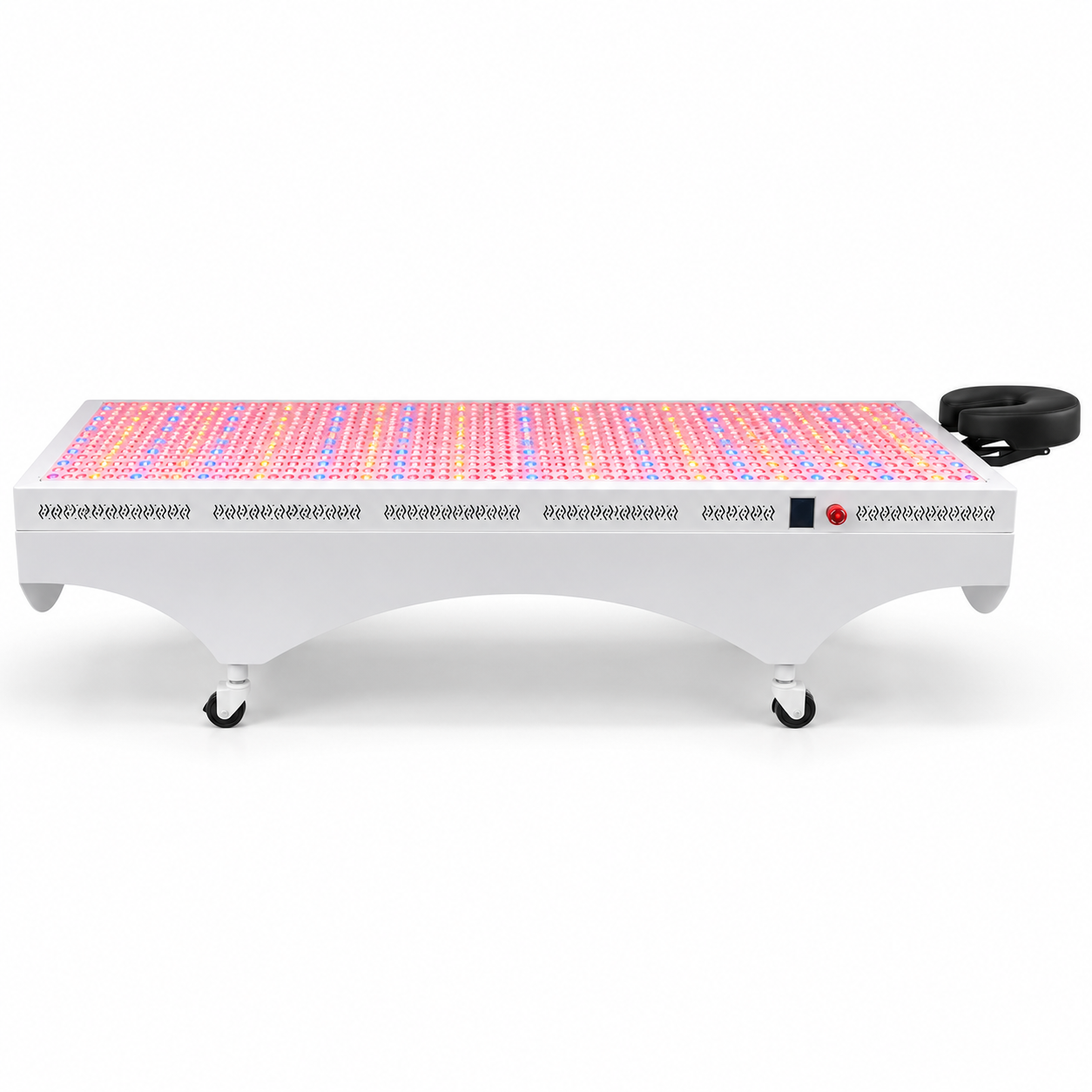
These distinctions apply to several formats. Our red light therapy bed guide explains why broad-area coverage is another separate question; a larger receiving area does not supply the missing spectral information.

Why a fixed penetration chart can mislead
Wavelength influences how light interacts with tissue, but it does not supply one universal depth. Tissue properties and illumination geometry also affect light distribution. “Penetration” needs a definition: detecting some light at a location is different from showing an exposure sufficient for a particular biological or clinical result.
A computational study of wavelength and beam width illustrates the role of model assumptions and geometry. Its monochromatic wavelength sweep covered 300–750 nm, alongside separate beam-width modeling. It was not a clinical comparison of 660 nm and 850 nm, and its modeled contours are not a depth guarantee for a home panel.
Avoid treating “660 nm for skin” and “850 nm for muscles” as exclusive compartments. Light does not skip the surface simply because it is near-infrared. More importantly, an optical pathway is not evidence that a particular condition will improve. This article supplies no fixed millimeter or centimeter chart for those two labels.
What a multi-wavelength study actually tests
When researching red light therapy wavelengths, identify what was compared before accepting the headline. Was it one wavelength against another, a combined source against sham, or two systems whose spectrum and delivery differed together?
A controlled study of narrower and broader lamp spectra did not find a significant broader-spectrum advantage in its assessed skin outcomes. The sources were gas-discharge lamps, with red emissions predominantly in 611–650 nm and broader emissions spanning 570–850 nm. Several delivery conditions differed, so this was not a clean test of adding particular LED bands.
Treatment assignments were randomized, while the untreated control group was recruited without randomization, mainly from company employees. The study had no sham, and the sponsor funded it, supplied equipment and paid investigators. Those limitations matter when interpreting the findings. A nonsignificant difference does not prove equivalence or show that extra wavelengths never help.
A combined 630 nm and 850 nm mask trial illustrates a different attribution problem: testing the combined intervention against sham cannot isolate the independent contribution of 850 nm. That observation concerns the study design; it does not validate a panel or bed with matching labels.
What to request when comparing red light therapy wavelengths
Ask for the information needed to understand the spectral claim, rather than a longer benefits list.
| Item to clarify | What it helps establish |
|---|---|
| Definition of the listed wavelength | Whether the number is nominal, a measured peak or another stated convention |
| Spectrum and spectral width | How emission is distributed around the listed bands |
| Band-resolved output, if available | The contributions hidden by an aggregate figure |
| Settings and measurement conditions | Which configuration the report actually describes |
| Study intervention and comparator | Whether evidence concerns the whole system or isolates a component |
Missing information is an unanswered question, not permission to assume equal output or equivalent effects. For the broader buying decision, our panel selection guide covers fit, measurement context and evidence without turning wavelength count into a score.
Visibility does not replace precautions
Neither a visible red glow nor an invisible component establishes safe exposure. Follow the exact model’s directions and use the eye protection they specify. Do not look directly into emitters to check whether near-infrared is working.
The American Academy of Dermatology’s home-use guidance advises discussing relevant light sensitivity and medicines with a dermatologist and using the recommended protection when the instructions require it. This is limited skin-device guidance, not approval for direct-eye treatment or a universal whole-body routine. Our panel safety guide provides the corresponding reminder to start with model instructions.
Frequently asked questions
Are more red light therapy wavelengths always better?
Wavelength count alone cannot establish that. Check what each band contributes and whether relevant research supports the claimed outcome for the complete intervention. A longer list supplies more labels, not a demonstrated improvement.
Is 850 nm a stronger version of 660 nm?
No. They describe different wavelengths. Strength needs a defined optical quantity and measurement conditions; a larger wavelength number does not answer that question.
Are 630 nm and 660 nm interchangeable?
Both are visible red, but they are different wavelengths. Sharing a broad category does not establish identical exposure or clinical results. Check the actual spectrum and the intervention studied rather than assuming either equivalence or superiority.
Do dark-looking LEDs mean the panel is broken?
Not necessarily: near-infrared may not be visibly bright. That does not prove the device is operating correctly either. Follow documented troubleshooting steps and contact the supplier when operation remains uncertain; visual inspection is not a calibrated output test.
Read the specification before assigning a benefit
Treat red light therapy wavelengths as the beginning of an explanation. Identify what the labels mean, what the measurements describe and what the research actually compared. Keep those answers separate before deciding that matching numbers mean matching results.


