


Red Light Therapy Irradiance: How to Read mW/cm² Claims
Oct 15,2026 | LumHarbor
Red light therapy irradiance — Quick Answer
Red light therapy irradiance describes optical power arriving per unit area at a specified receiving surface. A number in mW/cm² is useful only when its distance, operating mode, spectral range and measurement method are clear. A center reading does not establish an area average, and a temporal peak is different from a time average. Converting units cannot correct an inaccurate measurement. Nor does a calibrated reading establish a clinical benefit or a suitable treatment schedule. To compare reports, first identify which quantity each number represents, where and how it was measured, and what “peak” or “average” means. Keep those measurement questions separate from the device’s operating instructions and evidence for health claims.
Start with the quantity, then check the units
Two red light therapy irradiance claims can use identical units while describing different measurement situations. Before comparing the larger number, identify what each report actually measures.
The CIE definition of irradiance concerns radiant power arriving per unit area at a point on a real or imaginary surface. That receiving surface might be a defined test plane. It is not automatically the panel’s emitting face or a person’s entire skin surface.
| Label | What the number describes | What to keep separate |
|---|---|---|
| Electrical input, W | Electrical power consumed | Optical power reaching the receiving plane |
| Radiant power, W | Power carried by light | Its spatial distribution over a specified area |
| Irradiance, mW/cm² or W/m² | Incident optical power per unit area | Exposure accumulated over time |
| Radiant exposure, J/cm² | Incident radiant energy per unit area over an interval | Absorbed tissue energy or a clinical result |
The NIST SI reference supplies the unit relationships. Since one milliwatt is 0.001 watt and one square centimeter is 0.0001 square meter, 1 mW/cm² equals 10 W/m². Therefore, 100 W/m² equals 10 mW/cm².
That factor of ten changes the units. It does not correct a meter’s spectral response, validate a test setup or establish an effective treatment level. For the broader buying questions, see our panel selection guide.
A center reading cannot establish the area average
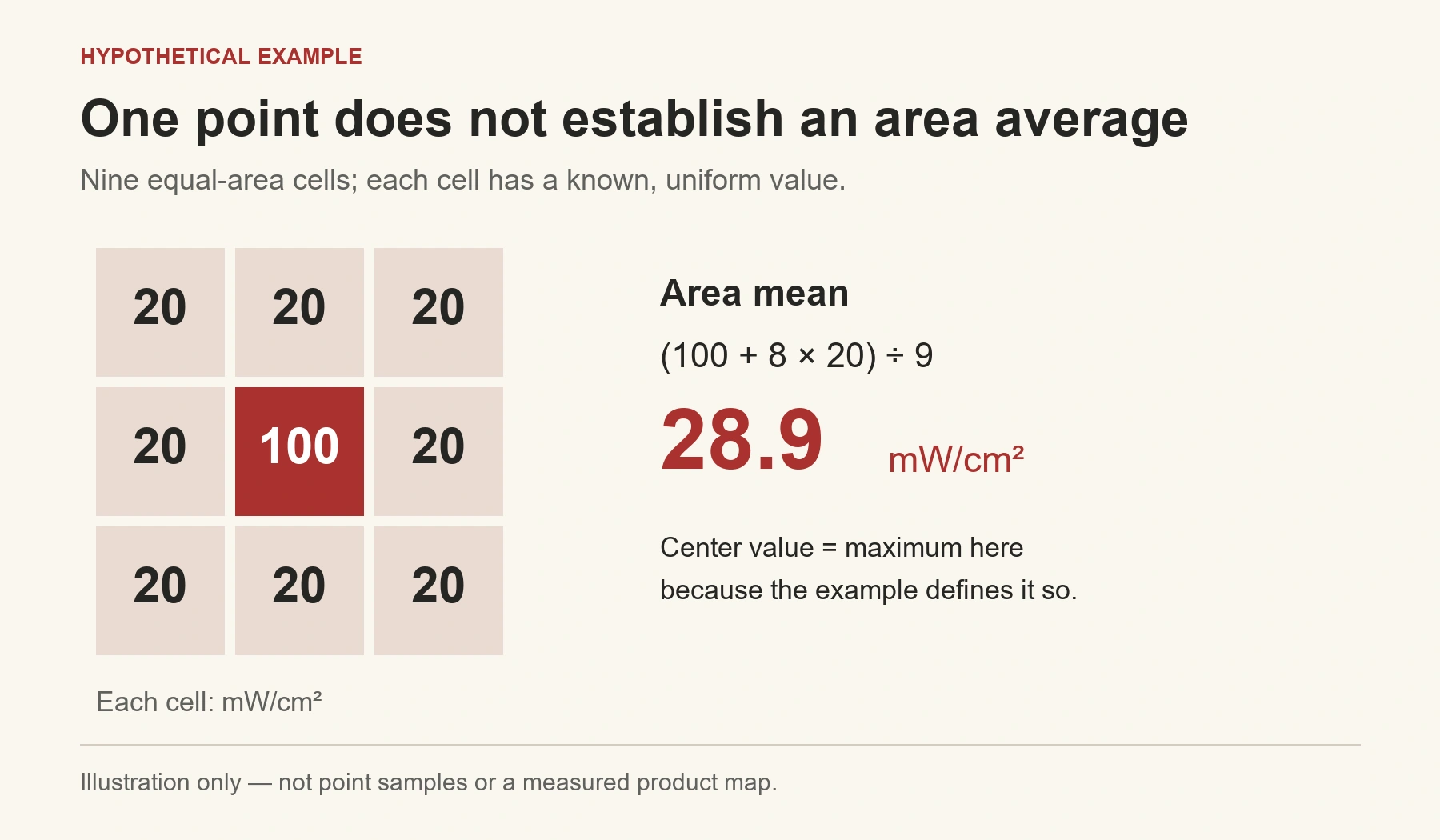
Imagine a fictional flat receiving surface divided into nine equal-area cells. The center cell has an irradiance of 100 mW/cm², while each of the other eight cells has 20 mW/cm². Assume the value is known and uniform throughout every cell.
The area average is then (100 + 8 × 20) ÷ 9, or approximately 28.9 mW/cm². In this invented example, the center value is also the maximum because we defined it that way.
This is a mathematical illustration, not a product test or a nine-point measurement procedure. Nine isolated readings would not establish that every cell is uniform or that all maxima had been captured. Unequal represented areas also require area weighting rather than a simple average of the numbers.
When reading red light therapy irradiance reports, ask which area the average covers and how it was estimated. A uniform field could have the same center, maximum and mean value. The limitation is that one point cannot establish whether that is true.
The technical review The dark art of light measurement explains why receiving geometry and spatial distribution matter. Its historical research audit should not be treated as a survey of today’s products, and its general measurement discussion does not validate any particular panel.
“Peak” and “average” can refer to different dimensions
For red light therapy irradiance, an average across an area and an average over time answer different questions. A report should identify the dimension rather than leaving “peak” or “average” unexplained.
| Term | Question it answers | Information still needed |
|---|---|---|
| Spatial maximum | Where is the highest value in the assessed field? | Search area, sampling method and receiving plane |
| Area average | What is the mean over a defined area? | Area boundaries, distribution and weighting |
| Temporal peak | What is the highest instantaneous value at a location? | Waveform and measurement bandwidth |
| Time average | What is the mean over a stated interval? | Interval, pulse shape and averaging method |
Consider a second fictional example at one fixed point: stable rectangular pulses switch between 80 mW/cm² and zero, with the light on for half of each cycle. Over complete cycles, the time average is 40 mW/cm².
The result depends on those assumptions. A nonzero off-level contributes to the average; a different pulse shape requires integration of that shape. Frequency alone does not specify the fraction of time the light is on. A device’s “50%” control setting also does not, by itself, establish a 50% optical duty cycle or half the measured output.
Ophir’s technical explanation of peak power explicitly qualifies calculations by temporal shape. Its laser-engineering examples explain a measurement distinction, not a therapeutic advantage of pulsing. Similarly, a meter’s highest captured sample need not be the physical optical peak, and an unspecified software average need not represent the relevant time interval.

A meter name is only part of the evidence
A red light therapy irradiance report should identify the instrument and sensor, their relevant calibration and spectral range, and the collection geometry. “Spectrometer tested” alone cannot establish that absolute irradiance was measured accurately. Equally, a photodiode-based instrument should not be dismissed solely because it uses a photodiode.
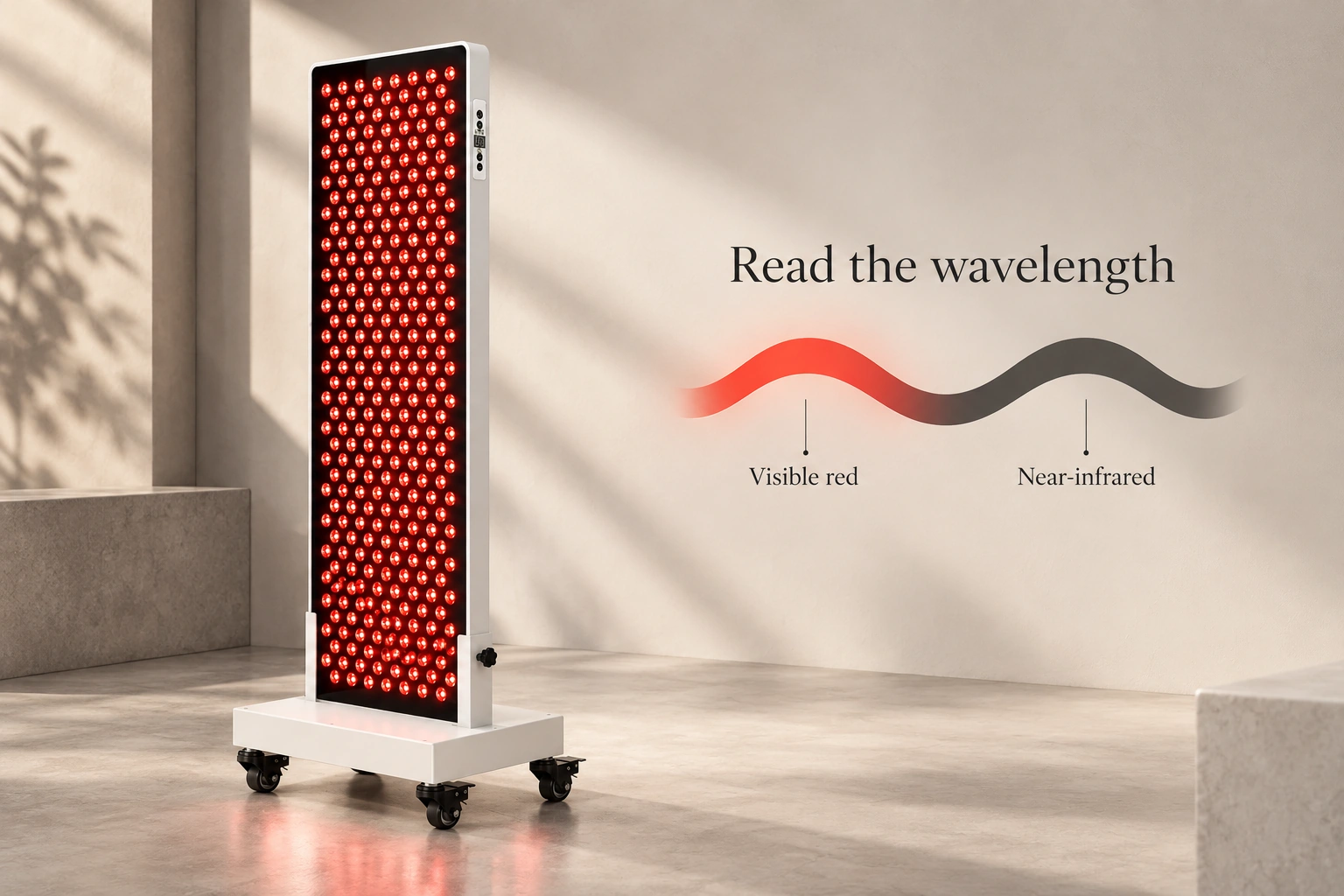
Mixed red and near-infrared output makes spectral response especially relevant. A single wavelength setting does not establish that the complete mixed spectrum was measured correctly. The appropriate treatment depends on the spectrum, detector response and calibrated method. Our wavelength guide explains why one combined reading does not reveal every band’s contribution.
NIST’s radiometry description distinguishes calibration modes and includes distance and field nonuniformity in its uncertainty discussion. Its facility-specific performance cannot be assigned to an unrelated consumer meter. More decimal places also do not establish greater accuracy or justify ranking closely spaced readings without uncertainty information.
There is no universal correction factor that turns every solar-meter reading into a validated red/NIR result. The unit conversion above is exact arithmetic; a sensor correction requires evidence about the actual system.
Why lux is a different quantity
The CIE definition of illuminance describes a photometric quantity expressed in lux, related to spectral irradiance through visual-response weighting. It is not interchangeable with unweighted optical power per area.
Known spectral information and an appropriate measurement model can support a conversion. An unspecified red/NIR mixture does not supply those inputs, so an arbitrary lux or phone reading cannot establish its irradiance through a universal multiplier.
Match the distance, plane and operating mode
Comparing red light therapy irradiance requires comparable conditions. Check the distance reference points, sensor orientation, enabled channels and output settings. Also check whether each number describes a center point, an area estimate, a temporal peak or an interval average.
Do not manufacture a panel’s distance curve from one reading using an unconditional inverse-square shortcut. Newport’s lamp measurement discussion makes its distance relationship conditional on source geometry and separation. That lamp example neither supplies a consumer LED-panel curve nor proves that inverse-square behavior can never apply.
Our panel setup guide covers practical placement context. A measurement report still needs its own defined geometry; it is not a replacement for the actual device instructions.
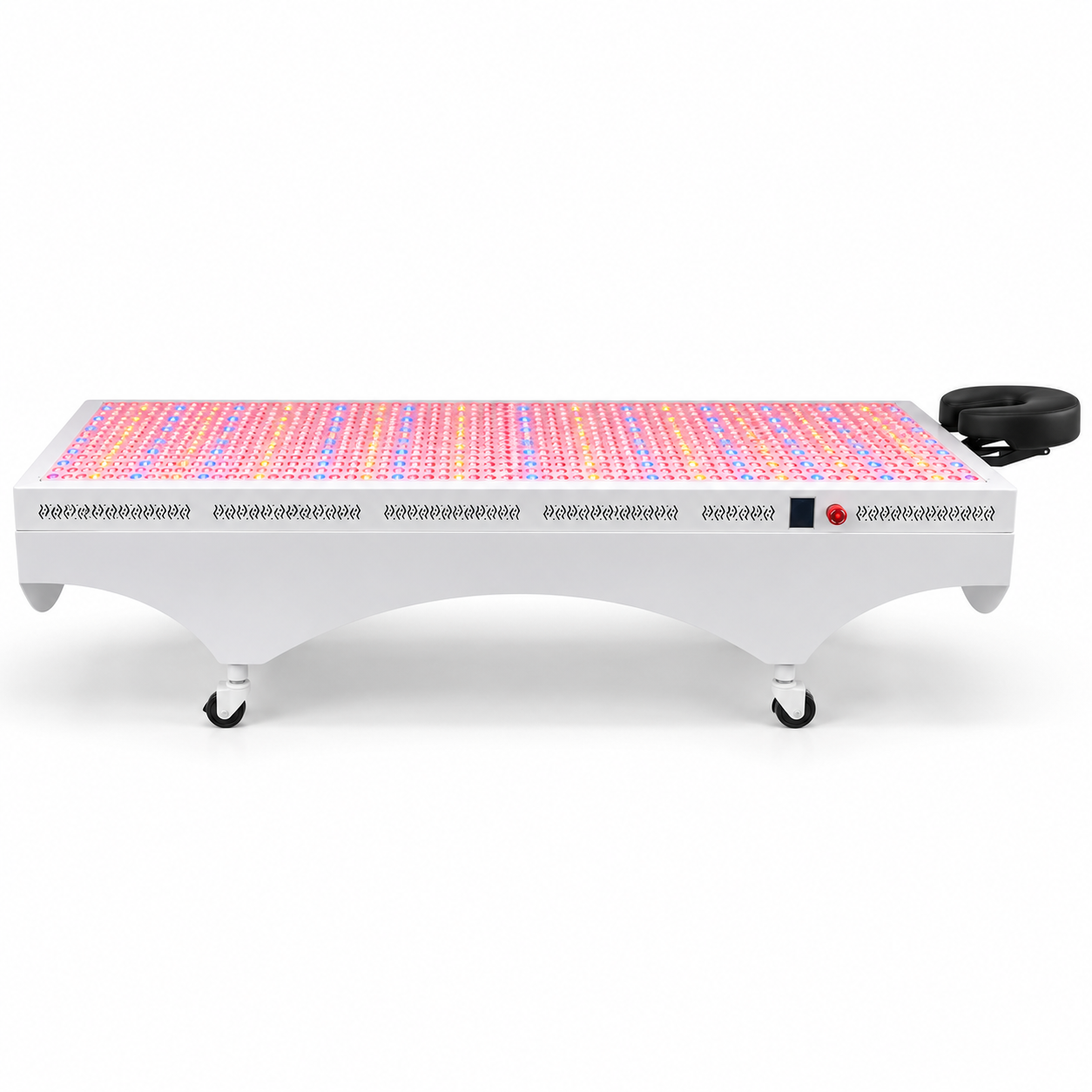
A flat-plane map also cannot establish exposure at every point on a curved person. Our red light therapy bed guide explains the equipment format, while the same distinction between a measured plane and a person remains important. Multiplying one point peak by an entire panel or body area does not recover total received power without the necessary spatial information.
Exposure arithmetic cannot choose your routine
Radiant exposure accumulates incident irradiance over time. For constant irradiance, multiplying W/cm² by seconds gives J/cm². If irradiance is expressed in mW/cm², divide that product by 1,000. A valid average over the full interval can also be used; a temporal peak cannot simply replace it.
This calculation describes an incident physical quantity at the stated location. It does not establish how much energy is absorbed within tissue, whether different intensity-and-time combinations produce the same biological outcome, or what session you should use. No LumHarbor model’s measured output or clinical benefit is established by the examples in this article.
The American Academy of Dermatology’s home-device guidance supports following device directions and specified eye protection. Its skin-device guidance is not a whole-body safety certification. Consult our panel safety guide for the questions to check alongside the exact-model instructions.
Frequently asked questions
Is higher irradiance automatically better?
No. Red light therapy irradiance is a measurement quantity, not a clinical outcome. First establish whether the figures are comparable; the larger number alone cannot establish greater benefit or a suitable personal routine.
Can a center reading equal the area average?
Yes. It can in a uniform field, and a center value can also coincide with the mean in a nonuniform field. One reading does not establish either situation.
Does a pulse-frequency label tell me the average output?
No. You also need the waveform’s levels, on-time and shape, together with an appropriate measurement method. Frequency alone does not determine duty cycle.
What should I request when two reports disagree?
Request the quantity and units, receiving plane and distance, operating mode, spatial and temporal definitions, instrument and sensor details, calibration scope and uncertainty. Differences may reflect different measurement situations; disagreement alone does not identify which report is correct.